Voice coil motors are widely used in precision engineering systems that require fast response, smooth motion, and extremely accurate positioning. Their electromagnetic operating principle allows them to generate controlled motion with minimal mechanical complexity, making them essential in modern automation, robotics, and optical systems.
In advanced motion control applications, a voice coil motor is valued for its direct-drive structure, which eliminates gears, belts, and screw mechanisms. This enables highly responsive motion with virtually no backlash, allowing both linear and rotational micro-movements to be controlled with exceptional precision.
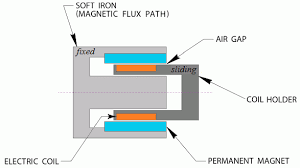
The working principle of a voice coil motor is based on the Lorentz force effect. When an electric current flows through a coil placed within a permanent magnetic field, a force is generated perpendicular to both the magnetic field and current direction.
This force can be precisely controlled by adjusting the magnitude and polarity of the current, enabling smooth and continuous motion. The simplicity of this electromagnetic interaction is what allows voice coil motors to achieve high precision without mechanical transmission losses.
Key characteristics include:
Direct relationship between current and force
Instantaneous response to input signals
Reversible motion by changing current direction
Smooth force output without cogging effects
Enabling Precise Linear Movement
Voice coil motors are commonly used for linear motion applications where high accuracy and smooth travel are required. The direct-drive mechanism ensures that motion is not affected by mechanical backlash or friction.
Linear precision is achieved through:
Low moving mass for fast acceleration
Stable magnetic field for consistent force output
High-resolution feedback systems for position control
Closed-loop control for real-time adjustments
These features make them ideal for applications such as optical focusing, semiconductor positioning, and micro-scale alignment systems.
Enabling Controlled Rotational Movement
Although primarily known for linear motion, voice coil motors can also be configured to produce rotational movement. This is achieved by designing the coil and magnetic structure in a circular arrangement, allowing torque to be generated instead of linear force.
Rotational precision is achieved through:
Uniform magnetic flux distribution across the rotation arc
Controlled current input for angular positioning
Feedback systems measuring angular displacement
Compact rotary stage integration for precision systems
This makes them suitable for applications requiring fine angular adjustments, such as camera stabilization and precision optical alignment.
Role of Electromagnetic Design
The performance of a voice coil motor depends heavily on its electromagnetic design. A well-optimized magnetic circuit ensures consistent force or torque output across the entire motion range.
Important design factors include:
Strong and uniform magnetic field using rare-earth magnets
Optimized coil geometry for efficient energy conversion
Precise air gap control for stable performance
Low magnetic leakage to improve efficiency
A well-engineered magnetic system ensures predictable and repeatable motion behavior.
Advantages in Precision Motion Systems
Voice coil motors offer several advantages over traditional mechanical motion systems:
High-speed response with minimal delay
Smooth motion without mechanical backlash
Excellent positioning accuracy
Compact and lightweight construction
Low mechanical wear and high reliability
These advantages make them ideal for high-performance systems where precision is critical.
Applications in Modern Engineering
Voice coil motors are widely used in industries that require both linear and rotational precision control, including:
Semiconductor wafer alignment and inspection systems
Optical lens focusing and imaging equipment
Medical diagnostic and surgical devices
Robotics requiring micro-positioning control
Precision calibration and testing instruments
In these applications, both speed and accuracy are essential for optimal performance.
Conclusion
Voice coil motors enable precise linear and rotational movement through direct electromagnetic force control. Their simple yet powerful operating principle allows for highly accurate, smooth, and responsive motion in demanding applications. As precision engineering continues to evolve, voice coil motor technology will remain a key solution for advanced motion control systems.