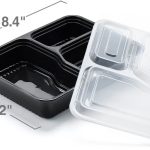

Planning inventory for food packaging requires more than estimating how many containers a business uses each week. Deli containers come in different sizes, materials, shapes, and lid configurations, so purchasing decisions should reflect actual product demand, storage capacity, and ordering schedules.
For businesses sourcing Deli Containers Wholesale, a structured inventory plan can help prevent both shortages and unnecessary overstock. The goal is to maintain enough packaging for daily operations while keeping storage space and purchasing costs under control.
Understand Your Container Usage
Start by reviewing historical usage rather than relying on rough estimates. Look at how many containers were used over the previous several weeks or months and identify patterns in demand.
Separate usage by container size and type. A food business may use small containers for sauces and sides, medium containers for prepared foods, and larger containers for salads, soups, or bulk portions.
Tracking these categories individually makes it easier to identify which products need frequent replenishment and which can be ordered less often.
Calculate Average Inventory Demand
Once usage data is available, calculate the average number of containers used during a typical ordering period.
For example, if a business uses approximately 4,000 containers per month, its average weekly consumption is about 1,000 containers. This figure provides a starting point for determining order quantities.
It is also useful to account for seasonal changes. Demand may increase during holidays, catering periods, weekends, or promotional campaigns, making historical averages alone insufficient for some businesses.
Set a Practical Safety Stock
Safety stock provides a buffer when demand is higher than expected or a shipment arrives later than planned.
A simple approach is to keep additional inventory equivalent to a certain number of days or weeks of average usage. The appropriate amount depends on supplier lead times, delivery reliability, and how critical the containers are to daily operations.
Businesses with limited storage space may need a smaller safety stock, while operations that cannot easily replace packaging during a shortage may prefer a larger buffer.
Consider Supplier Lead Times
Lead time is one of the most important factors in inventory planning. If an order normally takes two weeks to arrive, purchasing should begin before the current stock reaches a critically low level.
Keep records of both the supplier’s stated lead time and the actual delivery time. If deliveries regularly take longer than expected, inventory calculations should reflect the real purchasing cycle.
It can also help to establish a reorder point based on expected consumption during the lead time plus the chosen safety stock.
Match Container Sizes to Product Demand
Ordering the right quantity is only part of inventory management. Businesses should also make sure they have the right mix of container sizes.
Review sales or production data to determine which portion sizes are most common. If one size accounts for most orders, it may justify more frequent purchasing, while less-used sizes can be ordered in smaller quantities.
Avoid assuming that larger containers are always more efficient to stock. Excess inventory of a slow-moving size can occupy valuable warehouse space and tie up purchasing funds.
Balance Order Quantity and Storage Space
Wholesale purchasing can make larger orders practical, but storage capacity should be considered before placing an order.
Measure the available storage area and estimate how many cases can be safely stored without blocking walkways, equipment, or other supplies. Containers and lids should also be protected from moisture, dust, and potential contamination.
A lower unit cost is not necessarily beneficial if the resulting inventory remains unused for an extended period or creates storage problems.
Track Lids Separately
Container lids deserve their own inventory count. A shortage of lids can make a large quantity of containers unusable, even when the containers themselves are fully stocked.
If lids and containers are purchased separately, monitor their usage rates and reorder points independently. Where possible, maintain a consistent ratio between containers and compatible lids.
Regular stock checks can also identify damaged, misplaced, or incompatible lids before they become an operational problem.
Use a Simple Reorder System
A straightforward inventory system can make replenishment more predictable. A basic reorder calculation can use:
Reorder Point = Average Daily Usage × Lead Time + Safety Stock
For example, if a business uses 150 containers per day, the supplier’s lead time is 10 days, and the desired safety stock is 500 containers, the reorder point would be 2,000 containers.
When available inventory approaches that level, the purchasing team can prepare the next order.
Review Inventory Regularly
Inventory planning should be treated as an ongoing process rather than a one-time calculation. Review usage, stock levels, supplier performance, and storage requirements regularly.
Monthly reviews may be sufficient for stable operations, while businesses with highly variable demand may benefit from weekly monitoring.
Over time, this process can reveal which container sizes move fastest, when demand changes, and whether current order quantities are appropriate.
Final Considerations
Effective deli container inventory planning combines demand forecasting, safety stock, supplier lead times, storage limitations, and product mix. By tracking these factors together, businesses can reduce the risk of running out of essential packaging without accumulating unnecessary stock.
The most reliable approach is to use actual consumption data and update purchasing decisions as demand changes. A simple, consistent inventory system can make wholesale container purchasing more predictable and easier to manage.