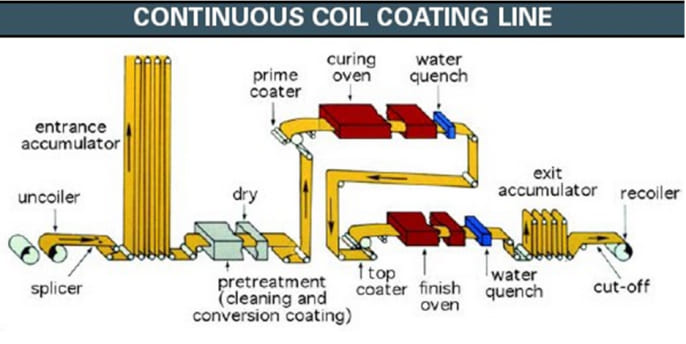

The metal processing industry is entering a new era driven by digital transformation, sustainability goals, and advanced manufacturing intelligence. A color coating line is no longer just a mechanical production system but an increasingly smart, connected, and highly automated platform. Future developments are focused on improving efficiency, reducing environmental impact, and enabling flexible production for diverse market demands.
A modern color coating line is evolving through innovations in automation, artificial intelligence, energy optimization, and advanced coating materials. These advancements are reshaping how manufacturers design, operate, and maintain continuous coating systems across global industries.
Table of Contents
ToggleIntegration of Industry 4.0 and Smart Manufacturing
One of the most significant developments in coating technology is the integration of Industry 4.0 principles. Smart factories rely on real-time data collection and intelligent decision-making systems to optimize production performance.
Future coating lines will increasingly include:
- IoT-enabled sensors for real-time monitoring
- Cloud-based production data management
- AI-driven process optimization
- Digital twin simulation systems
These technologies allow operators to predict issues, adjust parameters automatically, and improve overall process stability. Similar trends are already being widely adopted in advanced coil processing industries to improve precision and efficiency .
Artificial Intelligence and Predictive Automation
Artificial intelligence is expected to play a central role in the next generation of color coating lines. AI systems analyze production data to optimize coating thickness, curing temperatures, and line speed in real time.
Key future capabilities include:
- Predictive maintenance for equipment health
- Automatic defect detection using machine vision
- Self-adjusting process parameters
- Intelligent quality control systems
These improvements reduce downtime, minimize material waste, and enhance product consistency. AI-driven manufacturing is already being recognized as a key pillar of future industrial automation systems .
Advanced Automation and Robotics
Automation is becoming more sophisticated, moving beyond simple mechanical control toward fully autonomous production environments. Future color coating lines will integrate robotics for handling, inspection, and maintenance tasks.
Expected advancements include:
- Robotic coil handling and loading systems
- Automated coating application adjustments
- Real-time inspection using vision systems
- Collaborative robots working alongside operators
These systems reduce human error and increase production safety while improving overall efficiency.
Energy Efficiency and Sustainable Manufacturing
Sustainability is a major driver of innovation in coating line technology. Manufacturers are focusing on reducing energy consumption and minimizing environmental impact.
Future improvements include:
- Energy-efficient curing ovens
- Heat recovery and reuse systems
- Low-VOC and water-based coating compatibility
- Optimized airflow and insulation systems
UV and advanced curing technologies are also being explored to reduce energy usage while maintaining coating quality. These solutions support global efforts toward greener industrial production .
Material Innovation and Advanced Coatings
Future coating systems will need to support new generations of high-performance materials. These coatings will provide enhanced durability and functional properties beyond traditional protection.
Emerging material trends include:
- Nanotechnology-enhanced coatings
- Self-healing surface layers
- Anti-corrosion and anti-microbial finishes
- Multi-functional decorative coatings
These innovations will require more precise application and curing systems, pushing coating line technology toward greater precision and flexibility.
Flexibility and Modular Line Design
Manufacturers are increasingly demanding production systems that can adapt quickly to changing market requirements. As a result, future color coating lines will be designed with modular structures.
Key benefits include:
- Faster color and product changeovers
- Scalable production capacity
- Reduced downtime during upgrades
- Customizable process configurations
This flexibility allows manufacturers to respond quickly to demand shifts without major production interruptions.
Enhanced Quality Control Systems
Quality assurance will become more automated and data-driven. Advanced inspection technologies will ensure consistent coating performance across all production batches.
Future quality systems will include:
- Real-time surface defect detection
- Laser-based thickness measurement
- AI-assisted color consistency analysis
- Fully automated rejection and correction systems
These systems ensure higher reliability and reduced waste throughout production.
Conclusion
The future of color coating line technology is shaped by intelligent automation, sustainable engineering, and advanced material science. With the integration of AI, robotics, energy-efficient systems, and modular design, coating lines are becoming more efficient, flexible, and environmentally responsible.
As these innovations continue to evolve, manufacturers will benefit from improved productivity, reduced operational costs, and higher product quality. The transition toward smart, automated, and sustainable coating systems represents the next major step in industrial metal processing.