
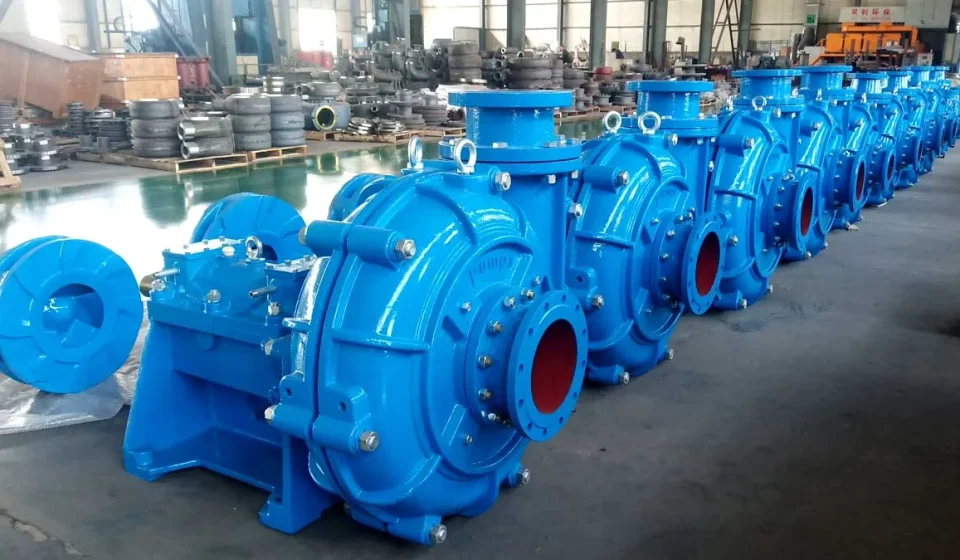

Choosing the right slurry pump material is important when handling abrasive or corrosive mixtures. The slurry’s particle size, concentration, temperature, and chemical properties can all affect pump performance and component life.
A centrifugal slurry pump may use rubber-lined or metal wetted components depending on the application. Although both designs can handle solid-liquid mixtures, they have different strengths and operating limitations.
What Is a Rubber-Lined Slurry Pump?
A rubber-lined pump uses rubber or elastomeric materials on selected internal surfaces that come into contact with the slurry. These liners provide a protective layer between the abrasive mixture and the structural components.
Rubber can offer good resistance to fine-particle abrasion and is often useful when the slurry contains relatively small and rounded solids.
What Is a Metal Slurry Pump?
Metal slurry pumps use wear-resistant metallic materials for components exposed to the slurry. High-chrome alloys are commonly considered for applications involving hard and highly abrasive particles.
Metal construction can provide strong resistance to severe wear and is often suitable for demanding mineral-processing and mining applications.
Key Differences Between Rubber and Metal Pumps
The main differences involve abrasion resistance, particle characteristics, temperature, chemical compatibility, and application conditions.
Abrasion Resistance
Rubber can perform well when handling fine abrasive particles, particularly when impact from large solids is limited. Its elasticity can help absorb some particle contact.
Metal components, especially hard alloy materials, are generally better suited to applications involving coarse, sharp, or highly abrasive particles.
The actual wear rate depends on the slurry characteristics rather than material type alone.
Particle Size
Particle size is an important consideration when comparing the two options.
Rubber-lined pumps are often more suitable for fine solids because large or sharp particles can cause cutting, tearing, or impact damage to rubber surfaces.
Metal construction may be preferable when the slurry contains larger particles that could create significant impact loads.
Temperature
Temperature can strongly influence material selection. Rubber and other elastomeric materials have specific operating temperature limits, and excessive heat can affect their flexibility and durability.
Metal components can generally tolerate higher temperatures, although the specific alloy and surrounding components still need to be suitable for the operating environment.
Chemical Compatibility
Both rubber and metal materials have different chemical resistance characteristics. A slurry that is chemically aggressive may affect one material more severely than another.
Rubber formulations differ in their resistance to acids, oils, solvents, and other chemicals. Metals also vary in their resistance to corrosion.
The chemical composition and temperature of the slurry should therefore be considered together when selecting materials.
Rubber-Lined Pump Advantages
Rubber-lined designs can provide several benefits under suitable operating conditions.
- Good resistance to fine-particle abrasion
- Reduced impact damage from some particle types
- Potentially lower weight for certain components
- Useful corrosion resistance with compatible elastomers
- Replaceable internal liners in many designs
These characteristics can make rubber a practical option for specific mineral-processing and slurry applications.
Limitations of Rubber-Lined Pumps
Rubber is not suitable for every slurry application. High temperatures can limit its use, while coarse or sharp particles may cause cutting and tearing.
Rubber can also swell, harden, soften, or deteriorate when exposed to incompatible chemicals. Material compatibility should therefore be confirmed before installation.
Metal Pump Advantages
Metal slurry pumps can offer strong performance in harsh abrasive conditions.
- High resistance to hard-particle wear
- Suitable for coarse solids in appropriate designs
- Greater tolerance of higher operating temperatures
- Strong mechanical durability
- Suitable for demanding mineral and mining applications
The specific metal alloy should be selected according to the hardness, concentration, and chemical properties of the slurry.
Limitations of Metal Pumps
Metal is not automatically the best choice for every application. Some metals may be vulnerable to corrosion when exposed to chemically aggressive slurry.
Metal components can also experience rapid wear when subjected to extremely abrasive materials at high velocities. Correct alloy selection and operating conditions remain important.
Rubber vs. Metal: A Practical Comparison
| Factor | Rubber-Lined | Metal |
|---|---|---|
| Fine abrasive particles | Generally suitable | Suitable |
| Coarse particles | Application dependent | Often preferred |
| Sharp particles | Can cause cutting | Generally more suitable |
| High temperature | More limited | Generally better suited |
| Chemical resistance | Depends on elastomer | Depends on alloy |
| Impact resistance | Flexible but can be damaged by coarse solids | Strong mechanical resistance |
| Severe abrasion | Application dependent | Often preferred |
| Maintenance | Liners may be replaceable | Wear parts may be replaceable |
The table provides general guidance only. Actual performance depends on the specific pump design and slurry characteristics.
How to Choose Between Rubber and Metal
The choice should begin with an analysis of the slurry rather than the pump material alone.
Consider the following factors:
Particle Size and Hardness
Fine, relatively uniform particles may favor rubber in suitable conditions. Large, hard, or sharp particles may require a more robust metallic construction.
Slurry Concentration
High solids concentrations can increase wear and energy requirements. The material should be selected according to the concentration and expected operating velocity.
Operating Temperature
If the slurry temperature approaches or exceeds the suitable range of an elastomer, metal may be the more practical option.
Chemical Properties
Determine whether the slurry is acidic, alkaline, saline, or contains other substances that could attack the selected material.
Required Service Life
Expected operating hours and maintenance access should also influence the decision. A material that provides a longer service interval under the actual conditions may reduce downtime.
Maintenance Considerations
Both rubber-lined and metal pumps require regular inspection. Wear components should be checked for erosion, cracking, deformation, and other signs of deterioration.
For rubber-lined pumps, look for swelling, hardening, tearing, or separation of the liner. For metal pumps, inspect high-wear areas for thinning, erosion, cracks, or changes in hydraulic clearances.
Conclusion
Rubber-lined and metal centrifugal slurry pumps each have advantages for specific operating conditions. Rubber can be effective for many fine-particle slurries and selected corrosive applications, while metal construction is often better suited to coarse, hard, and highly abrasive solids or higher-temperature service.
The best choice depends on particle size, hardness, concentration, temperature, chemical composition, flow velocity, and expected service life. Evaluating these factors together helps ensure that the pump material matches the actual demands of the slurry application.


